DEMO
Subject-Wise Performance Analysis
| Subject | Attempted / Total | Correct (+4) | Incorrect (-1) | Accuracy % | Net Subject Score |
|---|---|---|---|---|---|
| Botany | 0 / 164 | 0 | 0 | 0% | 0 |
Question-by-Question NCERT Solutions
Review your chosen responses with full textbook references
Q.1. Regarding the following cross AaBbCcDd×AABbCcDD Which statement is correct?
Concept: Mendelian Genetics & Principles of Inheritance. Question 1 tests key NEET principles from NCERT Class 12 Biology, Chapter 5: Principles of Inheritance and Variation. Correct option: (3).
Q.2. Given below are two statements; one is labelled as Assertion (A) and the other is labelled as Reason (R). Assertion (A): Unmodified Allele, which represents the original phenotype is the dominant allele Reason (R): A dominant allele could be modified into recessive allele by only crossing over In the light of the above statements, choose the correct answer from the options given below :
Concept: Mendelian Genetics & Principles of Inheritance. Question 2 tests key NEET principles from NCERT Class 12 Biology, Chapter 5: Principles of Inheritance and Variation. Correct option: (2).
Q.3. Proportion of progenies with round seeded and red flowered pea plants if cross is made between WwRr and ww Rr would be :-
Concept: Mendelian Genetics & Principles of Inheritance. Question 3 tests key NEET principles from NCERT Class 12 Biology, Chapter 5: Principles of Inheritance and Variation. Correct option: (1).
Q.4. Ratio of dominant and recessive for both character plants in F 2 generation of dihybrid cross is :-
Concept: Mendel Dihybrid & Monohybrid Crosses. Question 4 tests key NEET principles from NCERT Class 12 Biology, Chapter 5: Principles of Inheritance and Variation. Correct option: (4).
Q.5. What is the probability of gamete AbC produced by a plant having genotype AaBbCc (If all the genes are situated on different chromosomes)?
Concept: Mendelian Genetics & Principles of Inheritance. Question 5 tests key NEET principles from NCERT Class 12 Biology, Chapter 5: Principles of Inheritance and Variation. Correct option: (3).
Q.6. Identify A, B and C in the given representative figure showing an individual inflicted with down syndrome. A B C Small and Flat back Broad
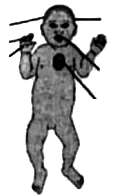
Concept: Chromosomal Disorders (Down, Turner, Klinefelter). Question 6 tests key NEET principles from NCERT Class 12 Biology, Chapter 5: Principles of Inheritance and Variation. Correct option: (2).
Q.7. A plant has genotype TtRrGgPP. On selfing of this plant, what is the sum total of phenotypic categories ?
Concept: Mendelian Genetics & Principles of Inheritance. Question 7 tests key NEET principles from NCERT Class 12 Biology, Chapter 5: Principles of Inheritance and Variation. Correct option: (1).
Q.8. Total number of genotypes and phenotypes in a dihybrid test cross is -
Concept: Mendel Dihybrid & Monohybrid Crosses. Question 8 tests key NEET principles from NCERT Class 12 Biology, Chapter 5: Principles of Inheritance and Variation. Correct option: (4).
Q.9. Which of the following crosses will produce 1 : 1 phenotypic ratio :-
Concept: Mendelian Genetics & Principles of Inheritance. Question 9 tests key NEET principles from NCERT Class 12 Biology, Chapter 5: Principles of Inheritance and Variation. Correct option: (3).
Q.10. What is the probability of obtaining pure homozygous individuals, if a cross is made between AaBbCcDd × aaBBCCdd individuals ? 2 1 (1) (2) 16 16 16 1 (3) (4) 248 64 2
Concept: Mendelian Genetics & Principles of Inheritance. Question 10 tests key NEET principles from NCERT Class 12 Biology, Chapter 5: Principles of Inheritance and Variation. Correct option: (2).
Q.11. Match Column I with Column II with respect to the scientists and their contributions in the development of genetics, as described in NCERT. Column I- Column II- Scientist Contribution/ W ork Experimental verification Gregor Johann A. 1 of chromosomal theory of Mendel inheritance Proposed the chromosomal B. Hugo de Vries 2 theory of inheritance along with Boveri Conducted hybridisation experiments on garden pea C. Carl Correns 3 and proposed laws of inheritance Erich von D. 4 Proposed mutation theory Tschermak Walter Independently rediscovered E. 5 Sutton Mendel's work Theodor Independently rediscovered F. 6 Boveri Mendel's work Thomas Hunt Independently rediscovered G. 7 Morgan Mendel's work Used recombination Alfred H. 8 frequency to map genes Sturtevant on chromosomes Which one of the following represents the correct matching?
Concept: Linkage & Genetic Mapping. Question 11 tests key NEET principles from NCERT Class 12 Biology, Chapter 5: Principles of Inheritance and Variation. Correct option: (1).
Q.12. A diploid organism is heterozygous for 3 loci, how many types of gametes can be produced?
Concept: Mendelian Genetics & Principles of Inheritance. Question 12 tests key NEET principles from NCERT Class 12 Biology, Chapter 5: Principles of Inheritance and Variation. Correct option: (4).
Q.13. Maximum height of a plant is 30ft. and minimum height is 10 ft. If plant height is controlled by 3 pairs of genes, then the height of plant with genotype AaBbCc will be -
Concept: Mendelian Genetics & Principles of Inheritance. Question 13 tests key NEET principles from NCERT Class 12 Biology, Chapter 5: Principles of Inheritance and Variation. Correct option: (3).
Q.14. If all the four children of a family will not have similar blood group, than what will be the blood group genotype of father & mother ?
Concept: Co-Dominance & Multiple Alleles. Question 14 tests key NEET principles from NCERT Class 12 Biology, Chapter 5: Principles of Inheritance and Variation. Correct option: (2).
Q.15. The ratio between carrier, disease free & diseased individual on marriage between two carriers of sickle cell anaemia will be -
Concept: Mendelian Genetics & Principles of Inheritance. Question 15 tests key NEET principles from NCERT Class 12 Biology, Chapter 5: Principles of Inheritance and Variation. Correct option: (1).
Q.16. A monohybrid cross between two plants, one having 24 cm long internode and other having 12 cm long internode, produces F 1 hybrid, all having 18 cm long internodes. This is a case of
Concept: Mendel Dihybrid & Monohybrid Crosses. Question 16 tests key NEET principles from NCERT Class 12 Biology, Chapter 5: Principles of Inheritance and Variation. Correct option: (4).
Q.17. In a linear chromosome, map distance between four loci are ab = 12, bc = 4, ad = 2, ac = 8. The distance between c and d will be -
Concept: Mendelian Genetics & Principles of Inheritance. Question 17 tests key NEET principles from NCERT Class 12 Biology, Chapter 5: Principles of Inheritance and Variation. Correct option: (3).
Q.18. What will be the percentage inheritance of a disorder from an X-linked diseased father to his son.
Concept: Mendelian Genetics & Principles of Inheritance. Question 18 tests key NEET principles from NCERT Class 12 Biology, Chapter 5: Principles of Inheritance and Variation. Correct option: (2).
Q.19. A homozygous recessive with cd genes was crossed with dominant (+ +). If their hybrid is test crossed and the following results were obtained + + - 900 c d - 880 + d - 115 + c - 105 Than what will be the distance between genes c and d.
Concept: Mendelian Genetics & Principles of Inheritance. Question 19 tests key NEET principles from NCERT Class 12 Biology, Chapter 5: Principles of Inheritance and Variation. Correct option: (1).
Q.20. Two genes a and b are linked and show 30% recombination. If ++ / ++ individual married with ab / ab then the types and proportion of gametes produced by F 1 will be -
Concept: Linkage & Genetic Mapping. Question 20 tests key NEET principles from NCERT Class 12 Biology, Chapter 5: Principles of Inheritance and Variation. Correct option: (4).
Q.21. A dihybrid plant with genotype PpNn. It produces four types of gametes in following number PN = 200, pn = 200, Pn = 800, pN = 800 then what is the distance between linked genes?
Concept: Mendel Dihybrid & Monohybrid Crosses. Question 21 tests key NEET principles from NCERT Class 12 Biology, Chapter 5: Principles of Inheritance and Variation. Correct option: (3).
Q.22. Find out the % of plants, which are dominant for both the character by the cross of with ab it's recessive form, if 20% recombination is present:-
Concept: Linkage & Genetic Mapping. Question 22 tests key NEET principles from NCERT Class 12 Biology, Chapter 5: Principles of Inheritance and Variation. Correct option: (2).
Q.23. Four genes A, B, C and D located on chromosome and cross over frequencies between different genes are : A – D 20%, A – C ? 4% C – D 16%, B – C ? 9% A – B = 5% Based on above data, what is the arrangement of linked genes on chromosome
Concept: Mendelian Genetics & Principles of Inheritance. Question 23 tests key NEET principles from NCERT Class 12 Biology, Chapter 5: Principles of Inheritance and Variation. Correct option: (1).
Q.24. A woman of normal vision whose father was colourblind, marries a man of normal vision, whose father was also colourblind. The sons of this marriage would be :-
Concept: Mendelian Genetics & Principles of Inheritance. Question 24 tests key NEET principles from NCERT Class 12 Biology, Chapter 5: Principles of Inheritance and Variation. Correct option: (4).
Q.25. By the cross of F 1 linked dihybrid plant with a plant of genotype aabb, we get the 1300 plants out of 2000 of parental type. The distance between A and B gene is :-
Concept: Mendel Dihybrid & Monohybrid Crosses. Question 25 tests key NEET principles from NCERT Class 12 Biology, Chapter 5: Principles of Inheritance and Variation. Correct option: (3).
Q.26. Genotype of plant is and there is 18% ab recombination present in it then percentage of gametes will be :-
Concept: Linkage & Genetic Mapping. Question 26 tests key NEET principles from NCERT Class 12 Biology, Chapter 5: Principles of Inheritance and Variation. Correct option: (2).
Q.27. Find out the number of dominant individual in a population of 6000, if the frequency of recessive phenotype is 25%
Concept: Mendelian Genetics & Principles of Inheritance. Question 27 tests key NEET principles from NCERT Class 12 Biology, Chapter 5: Principles of Inheritance and Variation. Correct option: (1).
Q.28. The frequency of an autosomal recessive allele is 0.4. Then what will be the frequency of heterozygotes in progeny among 4000 individual?
Concept: Mendelian Genetics & Principles of Inheritance. Question 28 tests key NEET principles from NCERT Class 12 Biology, Chapter 5: Principles of Inheritance and Variation. Correct option: (4).
Q.29. Find out the number of heterozygous free ear lobed persons in a population of 3000 if the proportion of fused ear lobed persons is 9%:
Concept: Mendelian Genetics & Principles of Inheritance. Question 29 tests key NEET principles from NCERT Class 12 Biology, Chapter 5: Principles of Inheritance and Variation. Correct option: (3).
Q.30. If in a population, frequency of organisms of recessive trait is 25% then calculate the frequency of recessive allele :
Concept: Mendelian Genetics & Principles of Inheritance. Question 30 tests key NEET principles from NCERT Class 12 Biology, Chapter 5: Principles of Inheritance and Variation. Correct option: (2).
Q.31. If the frequency of recesive phenotype is 9% then find out the number of homozygous organisms in population of 50,000 individuals:-
Concept: Mendelian Genetics & Principles of Inheritance. Question 31 tests key NEET principles from NCERT Class 12 Biology, Chapter 5: Principles of Inheritance and Variation. Correct option: (1).
Q.32. In the pedigree shown below, individuals with the solid symbols suffers from albinism. You would counsel the couple A & B that the probability that each of their child will have the disease is :-
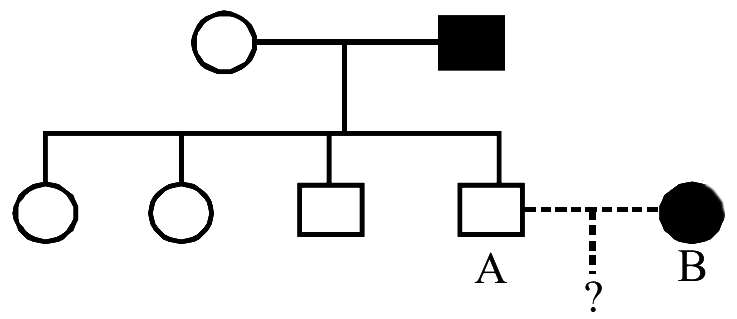
Concept: Pedigree Analysis. Question 32 tests key NEET principles from NCERT Class 12 Biology, Chapter 5: Principles of Inheritance and Variation. Correct option: (3).
Q.33. Given pedigree show inheritance of autosomal dominant disorder (myotonic dystrophy) then what will be genotype of shaded symbol :-
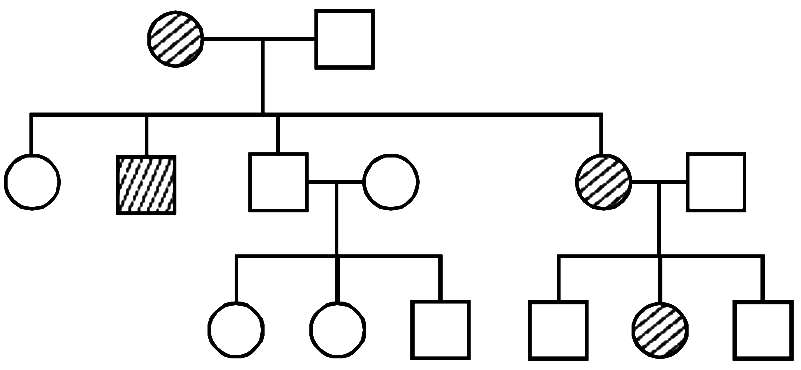
Concept: Pedigree Analysis. Question 33 tests key NEET principles from NCERT Class 12 Biology, Chapter 5: Principles of Inheritance and Variation. Correct option: (3).
Q.34. Predict from the following chart :-
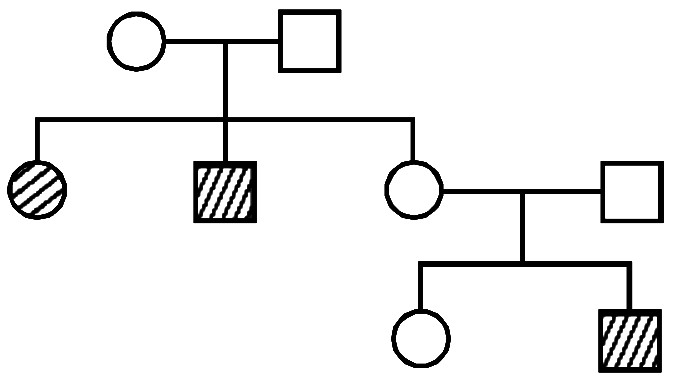
Concept: Mendelian Genetics & Principles of Inheritance. Question 34 tests key NEET principles from NCERT Class 12 Biology, Chapter 5: Principles of Inheritance and Variation. Correct option: (3).
Q.35. The map distance between A and C = 30 cM, B and C = 20 cM, A and B is 50 cM, B and D = 10 cM, C and D = 30 cM. What is the arrangement of ABCD gene on chromosome
Concept: Mendelian Genetics & Principles of Inheritance. Question 35 tests key NEET principles from NCERT Class 12 Biology, Chapter 5: Principles of Inheritance and Variation. Correct option: (1).
Q.36. Study the given pedigree carefully, the trait indicated is :-
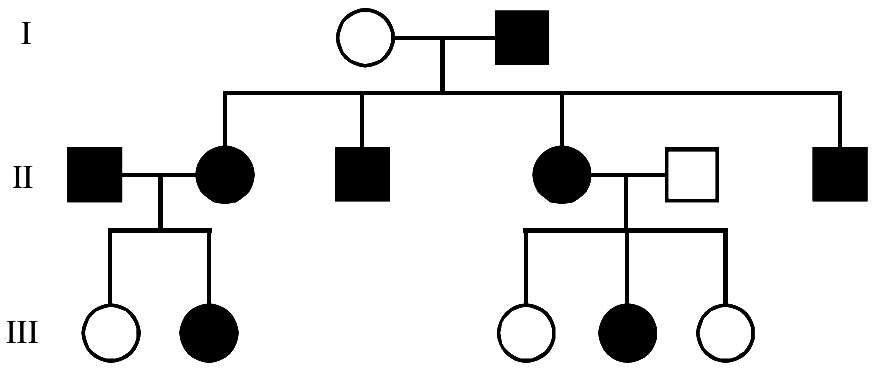
Concept: Pedigree Analysis. Question 36 tests key NEET principles from NCERT Class 12 Biology, Chapter 5: Principles of Inheritance and Variation. Correct option: (4).
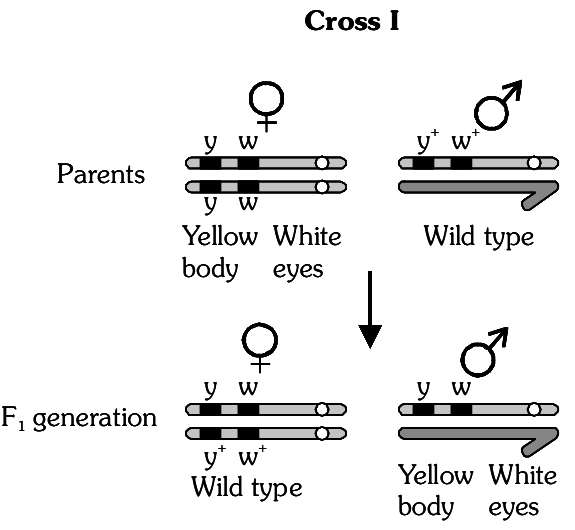
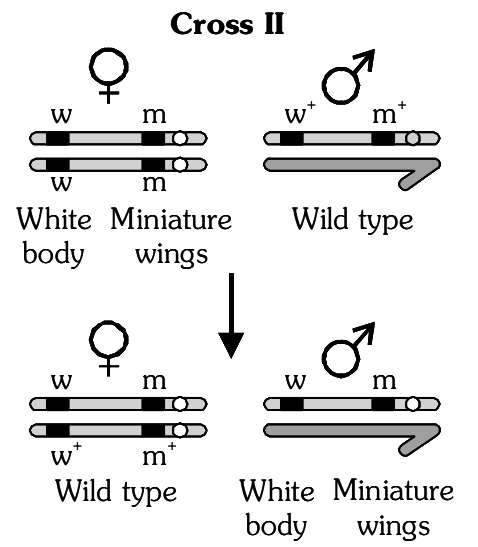
Q.37. Dihybrid cross conducted by Morgan in which yellow body and white eyed female Drosophila is crossed with wild type male then non-parental combinations obtain in F 2 -generation were :-
Concept: Linkage & Genetic Mapping. Question 37 tests key NEET principles from NCERT Class 12 Biology, Chapter 5: Principles of Inheritance and Variation. Correct option: (3).
Q.38. A husband and wife have normal vision but fathers of both of them were colour blind. Probability of their first daughter to be colour blind is
Concept: Mendelian Genetics & Principles of Inheritance. Question 38 tests key NEET principles from NCERT Class 12 Biology, Chapter 5: Principles of Inheritance and Variation. Correct option: (2).
Q.39. Match the list I with list II. List-I List-II Noted that the behaviour of chromosomes was parallel to the behaviour A. Boveri I. of genes and used chromosome movement to explain Mendel’s laws United the knowledge of Walter chromosomal segregation Sutton with Mendelian principles B. and II. and called it the Theodore chromosomal theory of Boveri inheritance. Used the frequency of recombination between gene pairs on the same chromosome as a C. Henking III. measure of the distance between genes and ‘mapped’ their position on the chromosome Alfred D. IV. Gave the name X body Sturtevant
Concept: Linkage & Genetic Mapping. Question 39 tests key NEET principles from NCERT Class 12 Biology, Chapter 5: Principles of Inheritance and Variation. Correct option: (1).
Q.40. As per ABO blood grouping system, the blood group of father is B + , mother is A + and child is O + . Their respective genotype can be A. I B i/I A i/ii B. I B I B /I A I A /ii C. I A i/I B i/I A i D. I A i/I B i/I A i E. iI B /iI A /I A I Choose the most appropriate answer from the options given below.
Concept: Co-Dominance & Multiple Alleles. Question 40 tests key NEET principles from NCERT Class 12 Biology, Chapter 5: Principles of Inheritance and Variation. Correct option: (4).
Q.41. In a cross between a male and female, both heterozygous for sickle cell anaemia gene, what percentage of the progeny will be diseased?
Concept: Mendelian Genetics & Principles of Inheritance. Question 41 tests key NEET principles from NCERT Class 12 Biology, Chapter 5: Principles of Inheritance and Variation. Correct option: (3).
Q.42. If two persons with 'AB' blood group marry and have sufficiently large number of children, these children could be classified as 'A blood group: 'AB' blood group: 'B' blood group in 1: 2: 1 ratio. Modern technique of protein electrophoresis 5 reveals presence of both 'A' and 'B' type proteins in 'AB blood group individuals. This in an example of
Concept: Co-Dominance & Multiple Alleles. Question 42 tests key NEET principles from NCERT Class 12 Biology, Chapter 5: Principles of Inheritance and Variation. Correct option: (2).
Q.43. A test cross is carried out to
Concept: Mendelian Genetics & Principles of Inheritance. Question 43 tests key NEET principles from NCERT Class 12 Biology, Chapter 5: Principles of Inheritance and Variation. Correct option: (1).
Q.44. In Antirrhinum two plants with pink flowers were hybridized. The F1 plants produced red, pink and white flowers in the proportion of 1 red, 2 pink and 1 white. What could be the genotype of the two plants used for hybridisation? Red flower colour is determined by RR and white by rr genes.
Concept: Mendelian Genetics & Principles of Inheritance. Question 44 tests key NEET principles from NCERT Class 12 Biology, Chapter 5: Principles of Inheritance and Variation. Correct option: (4).
Q.45. In pea plants, yellow seeds are dominant to green. If a heterozygous yellow seeded plant is crossed with a green seeded plant, what ratio of yellow and green seeded plants would you expect in F1 generation?
Concept: Mendelian Genetics & Principles of Inheritance. Question 45 tests key NEET principles from NCERT Class 12 Biology, Chapter 5: Principles of Inheritance and Variation. Correct option: (3).
Q.46. A man of A-blood group marries a woman of AB blood group. Which type of progeny would indicate that man is heterozygous A?
Concept: Co-Dominance & Multiple Alleles. Question 46 tests key NEET principles from NCERT Class 12 Biology, Chapter 5: Principles of Inheritance and Variation. Correct option: (2).
Q.48. A child's blood group is 'O. The parent's blood groups cannot be
Concept: Co-Dominance & Multiple Alleles. Question 48 tests key NEET principles from NCERT Class 12 Biology, Chapter 5: Principles of Inheritance and Variation. Correct option: (4).
Q.49. Blue eye colour is recessive to brown eye colour. A brown eyed man whose mother was blue eyed marries a blue-eyed woman. The children will be
Concept: Mendelian Genetics & Principles of Inheritance. Question 49 tests key NEET principles from NCERT Class 12 Biology, Chapter 5: Principles of Inheritance and Variation. Correct option: (3).
Q.50. The recombination frequency between the genes a & c is 5%, b & c is 15%, b & d is 9%, a & b is 20%, c & d is 24% and a & d is 29%. What will be the sequence of these genes on a linear chromosome?
Concept: Linkage & Genetic Mapping. Question 50 tests key NEET principles from NCERT Class 12 Biology, Chapter 5: Principles of Inheritance and Variation. Correct option: (2).
Q.51. What map unit (centimorgan) is adopted in the construction of genetic maps?
Concept: Linkage & Genetic Mapping. Question 51 tests key NEET principles from NCERT Class 12 Biology, Chapter 5: Principles of Inheritance and Variation. Correct option: (1).
Q.52. There are three genes a, b, c. Percentage of crossing over between a and b is 20%, b and c is 28% and a and c is 8%. What is the sequence of genes on chromosome?
Concept: Mendelian Genetics & Principles of Inheritance. Question 52 tests key NEET principles from NCERT Class 12 Biology, Chapter 5: Principles of Inheritance and Variation. Correct option: (4).
Q.53. Due to the cross between TTRr × ttrr the resultant progenies show what percent of tall, red flowered plants?
Concept: Mendelian Genetics & Principles of Inheritance. Question 53 tests key NEET principles from NCERT Class 12 Biology, Chapter 5: Principles of Inheritance and Variation. Correct option: (3).
Q.54. In a cross between AABB x aabb, the ratio of F 2 genotypes between AABB, AaBB, Aabb and aabb would be
Concept: Mendelian Genetics & Principles of Inheritance. Question 54 tests key NEET principles from NCERT Class 12 Biology, Chapter 5: Principles of Inheritance and Variation. Correct option: (2).
Q.55. Cross between AaBB and aaBB will form
Concept: Mendelian Genetics & Principles of Inheritance. Question 55 tests key NEET principles from NCERT Class 12 Biology, Chapter 5: Principles of Inheritance and Variation. Correct option: (1).
Q.56. Bateson used the terms coupling and repulsion for linkage and crossing over. Name the correct parental of coupling type alongwith its cross over or repulsion.
Concept: Linkage & Genetic Mapping. Question 56 tests key NEET principles from NCERT Class 12 Biology, Chapter 5: Principles of Inheritance and Variation. Correct option: (4).
Q.57. Two linked genes a and b show 20% recombination. the individuals of a dihybrid cross between ++/ ++ × ab/ab shall show gametes
Concept: Linkage & Genetic Mapping. Question 57 tests key NEET principles from NCERT Class 12 Biology, Chapter 5: Principles of Inheritance and Variation. Correct option: (3).
Q.58. In the following human pedigree, the filled symbols represent the affected individuals. Identify the type of given pedigree.
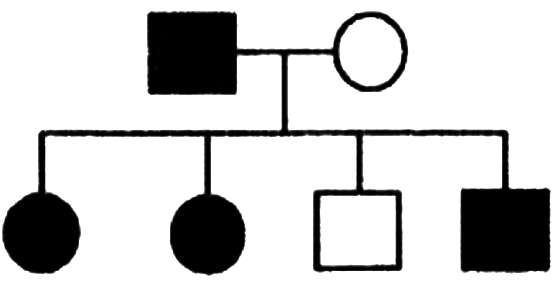
Concept: Pedigree Analysis. Question 58 tests key NEET principles from NCERT Class 12 Biology, Chapter 5: Principles of Inheritance and Variation. Correct option: (2).
Q.59. A man whose father was colour blind marries a woman who had a colour blind mother and normal father. What percentage of male children of this couple will be colour blind?
Concept: Mendelian Genetics & Principles of Inheritance. Question 59 tests key NEET principles from NCERT Class 12 Biology, Chapter 5: Principles of Inheritance and Variation. Correct option: (1).
Q.60. If both parents are carriers for thalassaemia, which is an autosomal recessive disorder, what are the chances of pregnancy resulting in an affected child?
Concept: Mendelian Genetics & Principles of Inheritance. Question 60 tests key NEET principles from NCERT Class 12 Biology, Chapter 5: Principles of Inheritance and Variation. Correct option: (4).
Q.61. A normal-visioned man whose father was colourblind, marries a woman whose father was also colour-blind. They have their first child as a daughter. What are the chances that this child would be colour-blind?
Concept: Mendelian Genetics & Principles of Inheritance. Question 61 tests key NEET principles from NCERT Class 12 Biology, Chapter 5: Principles of Inheritance and Variation. Correct option: (3).
Q.62. Represented here is the inheritance pattern of a certain type of trait in humans. Which one of the following conditions could be an example of this pattern?
Concept: Mendelian Genetics & Principles of Inheritance. Question 62 tests key NEET principles from NCERT Class 12 Biology, Chapter 5: Principles of Inheritance and Variation. Correct option: (2).
Q.63. Study the pedigree chart of a certain family given below and select the correct conclusion which can be drawn for the character.
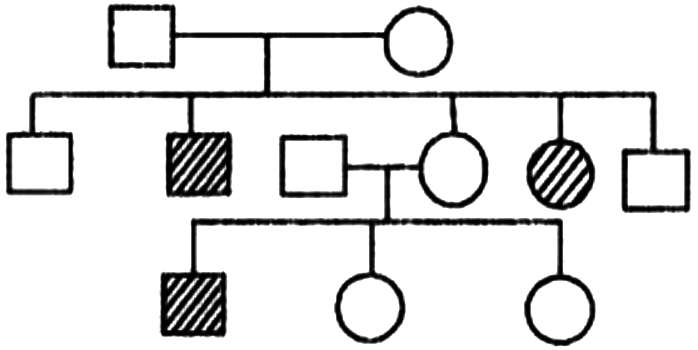
Concept: Pedigree Analysis. Question 63 tests key NEET principles from NCERT Class 12 Biology, Chapter 5: Principles of Inheritance and Variation. Correct option: (1).
Q.64. Study the pedigree chart given below. What does it show?
Concept: Pedigree Analysis. Question 64 tests key NEET principles from NCERT Class 12 Biology, Chapter 5: Principles of Inheritance and Variation. Correct option: (4).
Q.65. A man and a woman, who do not show any apparent signs of a certain inherited disease, have seven children (2 daughters and 5 sons). Three of the sons suffer from the given disease but none of the daughters affected. Which of the following mode of inheritance do you suggest for this disease?
Concept: Mendelian Genetics & Principles of Inheritance. Question 65 tests key NEET principles from NCERT Class 12 Biology, Chapter 5: Principles of Inheritance and Variation. Correct option: (3).
Q.66. A normal woman, whose father was colour-blind is married to a normal man. The sons would be
Concept: Mendelian Genetics & Principles of Inheritance. Question 66 tests key NEET principles from NCERT Class 12 Biology, Chapter 5: Principles of Inheritance and Variation. Correct option: (2).
Q.67. Which one of the following conditions though harmful in itself, is also potential saviour from a mosquito borne infectious disease?
Concept: Mendelian Genetics & Principles of Inheritance. Question 67 tests key NEET principles from NCERT Class 12 Biology, Chapter 5: Principles of Inheritance and Variation. Correct option: (1).
Q.68. A woman with two genes for haemophilia and one gene for colour blindness on one of the 'X chromosomes marries a normal man. How will the progeny be?
Concept: Mendelian Genetics & Principles of Inheritance. Question 68 tests key NEET principles from NCERT Class 12 Biology, Chapter 5: Principles of Inheritance and Variation. Correct option: (4).
Q.69. Haemophilic man marries a normal woman. Their offspring will be
Concept: Mendelian Genetics & Principles of Inheritance. Question 69 tests key NEET principles from NCERT Class 12 Biology, Chapter 5: Principles of Inheritance and Variation. Correct option: (3).
Q.70. Read the following statements and find out the incorrect statement. a. Genetics deals with the inhetitance, as well as variation of characters from parents to offspring. b. Variation is the process by which characters are passed on from parent to progeny. c. Inheritance is the basis of heredity d. Inheritance is the degree by which progeny differ from their parents e. Human knew from as early as 8000-10000 B.C. that one of the causes of variation was hidden in sexual reproduction
Concept: Mendelian Genetics & Principles of Inheritance. Question 70 tests key NEET principles from NCERT Class 12 Biology, Chapter 5: Principles of Inheritance and Variation. Correct option: (2).
Q.71. Sahiwal cow in ___a___ was developed by ___b___
Concept: Mendelian Genetics & Principles of Inheritance. Question 71 tests key NEET principles from NCERT Class 12 Biology, Chapter 5: Principles of Inheritance and Variation. Correct option: (1).
Q.72. Phenotype of an organism is the result of
Concept: Mendelian Genetics & Principles of Inheritance. Question 72 tests key NEET principles from NCERT Class 12 Biology, Chapter 5: Principles of Inheritance and Variation. Correct option: (4).
Q.74. Select one word for the statement. Dominance, co-dominance, incomplete dominance (a) If F 1 resembled both the parents (b) If F 1 did not resemble either of the two parents and was in between the two (c) If F 1 resembled either of the two parents
Concept: Co-Dominance & Multiple Alleles. Question 74 tests key NEET principles from NCERT Class 12 Biology, Chapter 5: Principles of Inheritance and Variation. Correct option: (2).
Q.75. In the case of Antirrhimum sp. the recessive trait is seen in progenies due to the (i) The normal enzyme (ii) Less-efficient enzyme (iii) Non-functional enzym (iv) No enzyme at all Select the correct optio among (i-iv)
Concept: Mendelian Genetics & Principles of Inheritance. Question 75 tests key NEET principles from NCERT Class 12 Biology, Chapter 5: Principles of Inheritance and Variation. Correct option: (1).
Q.76. tt mates with Tt. What will be characteristic of offspring?
Concept: Mendelian Genetics & Principles of Inheritance. Question 76 tests key NEET principles from NCERT Class 12 Biology, Chapter 5: Principles of Inheritance and Variation. Correct option: (4).
Q.77. Mendel's principle of segregation is based on separation of alleles during
Concept: Mendelian Genetics & Principles of Inheritance. Question 77 tests key NEET principles from NCERT Class 12 Biology, Chapter 5: Principles of Inheritance and Variation. Correct option: (3).
Q.78. O group mother with O group child sues AB group man for fathership of child. What is true?
Concept: Mendelian Genetics & Principles of Inheritance. Question 78 tests key NEET principles from NCERT Class 12 Biology, Chapter 5: Principles of Inheritance and Variation. Correct option: (2).
Q.79. Children in a family have blood types O, A, AB and B respectively. What are the genotypes of their parents?
Concept: Mendelian Genetics & Principles of Inheritance. Question 79 tests key NEET principles from NCERT Class 12 Biology, Chapter 5: Principles of Inheritance and Variation. Correct option: (1).
Q.80. If a pea produces 2560 seeds during a dihybrid cross between round-yellow and and wrinkledgreen plant. Then how many seed are wrinkledyellow, round-yellow and wrinkled- green respectively.
Concept: Mendel Dihybrid & Monohybrid Crosses. Question 80 tests key NEET principles from NCERT Class 12 Biology, Chapter 5: Principles of Inheritance and Variation. Correct option: (4).
Q.81. If there is complete linkage in F2 generation
Concept: Linkage & Genetic Mapping. Question 81 tests key NEET principles from NCERT Class 12 Biology, Chapter 5: Principles of Inheritance and Variation. Correct option: (3).
Q.82. Read the following statements. (i) In haplo-diploid sex-determination system, the males do not have father and thus cannot have sons, but have a grandfather and can have grandsons (ii) In honey bee, workers are developed by the unfertilized egg by means of parthenogenesis (iii) In human skin colour, the effect of each allele is additive (iv) In XO type of sex-determination, male have half number of chromosome than the female Select the incorrect statement.
Concept: Mendelian Genetics & Principles of Inheritance. Question 82 tests key NEET principles from NCERT Class 12 Biology, Chapter 5: Principles of Inheritance and Variation. Correct option: (2).
Q.83. Choose the wrong statement.
Concept: Mendelian Genetics & Principles of Inheritance. Question 83 tests key NEET principles from NCERT Class 12 Biology, Chapter 5: Principles of Inheritance and Variation. Correct option: (1).
Q.84. Which is incorrect about colour blindness?
Concept: Mendelian Genetics & Principles of Inheritance. Question 84 tests key NEET principles from NCERT Class 12 Biology, Chapter 5: Principles of Inheritance and Variation. Correct option: (4).
Q.85. Read the following statements and find out the incorrect statement.
Concept: Mendelian Genetics & Principles of Inheritance. Question 85 tests key NEET principles from NCERT Class 12 Biology, Chapter 5: Principles of Inheritance and Variation. Correct option: (3).
Q.86. A woman with two genes, one for haemophilia and one for colour blindness on one of its Xchromosomes, marries a normal man. The progeny will be :-
Concept: Mendelian Genetics & Principles of Inheritance. Question 86 tests key NEET principles from NCERT Class 12 Biology, Chapter 5: Principles of Inheritance and Variation. Correct option: (2).
Q.87. A male human is heterozygous for autosomal genes A and B. He is also hemizygous for haemophilic gene h. What proportion of sperms will carry abh?
Concept: Mendelian Genetics & Principles of Inheritance. Question 87 tests key NEET principles from NCERT Class 12 Biology, Chapter 5: Principles of Inheritance and Variation. Correct option: (1).
Q.89. Select the incorret statement from the following.
Concept: Mendelian Genetics & Principles of Inheritance. Question 89 tests key NEET principles from NCERT Class 12 Biology, Chapter 5: Principles of Inheritance and Variation. Correct option: (3).
Q.90. Which of the following statements is not true of two genes that show 50% recombination frequency?
Concept: Linkage & Genetic Mapping. Question 90 tests key NEET principles from NCERT Class 12 Biology, Chapter 5: Principles of Inheritance and Variation. Correct option: (2).
Q.92. The Punnet square shown below represents the pattern of inheritance in dihybrid cross when yellow (Y) is dominant over green (y) and round (R) is dominant ove wrinkled (r) seed. A plant of type 'H' will produce seeds with the genotype identical to seeds produced by the plants of
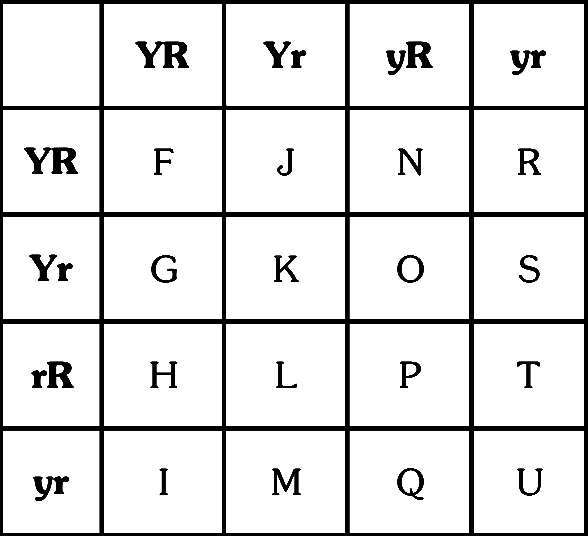
Concept: Mendel Dihybrid & Monohybrid Crosses. Question 92 tests key NEET principles from NCERT Class 12 Biology, Chapter 5: Principles of Inheritance and Variation. Correct option: (2).
Q.93. The correct match is
Concept: Mendelian Genetics & Principles of Inheritance. Question 93 tests key NEET principles from NCERT Class 12 Biology, Chapter 5: Principles of Inheritance and Variation. Correct option: (3).
Q.95. Predict from the following chart.
Concept: Mendelian Genetics & Principles of Inheritance. Question 95 tests key NEET principles from NCERT Class 12 Biology, Chapter 5: Principles of Inheritance and Variation. Correct option: (1).
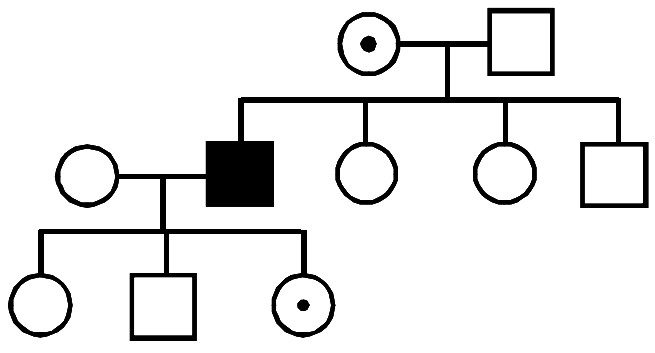
Q.96. Study the pedigree, chart of a certain family given below. It is related to myotonic dystrophy. The trait traced in the above pedigree chart is (1) Dominant X-linked (2) Recessive X-lined (3) Autosomal dominant(4) Recessive Y-lined
Concept: Pedigree Analysis. Question 96 tests key NEET principles from NCERT Class 12 Biology, Chapter 5: Principles of Inheritance and Variation. Correct option: (4).
Q.97. Red-green colour-blindness is a sex-linked trait in humans XC=normal allele and Xc=colourblind allele in the following cross. Which of the groups shown below consists of Patient grandparents?
Concept: Mendelian Genetics & Principles of Inheritance. Question 97 tests key NEET principles from NCERT Class 12 Biology, Chapter 5: Principles of Inheritance and Variation. Correct option: (3).
Q.98. Which of the following is suitable for experiments on linkage? (Coupling)
Concept: Linkage & Genetic Mapping. Question 98 tests key NEET principles from NCERT Class 12 Biology, Chapter 5: Principles of Inheritance and Variation. Correct option: (2).
Q.99. G 0 through following statements and choose the correct option. (A) Sutton united the knowledge of chromosomal segregation with Mendelian principles and called it the chromosomal theory of inheritance (B) Genes are the units of inheritance (C) There are 5 different alleles which determine ABO blood types (D) The phenotypic ratio of Mendelian monohibrid cross is 3 : 1
Concept: Mendelian Genetics & Principles of Inheritance. Question 99 tests key NEET principles from NCERT Class 12 Biology, Chapter 5: Principles of Inheritance and Variation. Correct option: (1).
Q.100. A true-breeding purple-flowered pea plant is crossed with a white-flowered plant. They produce two F1 progeny that are then mated with each other to yield 10 F 2 plants. The F 2 contains 5 purple-flowered plants and 5 whiteflowered plants. Which of the following is the best explanation for the F 2 results?
Concept: Mendelian Genetics & Principles of Inheritance. Question 100 tests key NEET principles from NCERT Class 12 Biology, Chapter 5: Principles of Inheritance and Variation. Correct option: (4).
Q.101. Go through following statements (I) Enborn error of metabolism (II) Homozygous recessive autosomal alleles on chromosome 12 cause the absence of the specific enzyme (III) A specific amino acid does not change into tyrosine (IV) Accumulation of phenylpyruvic acid and other derivatives lead to mental retardation The above facts refer to
Concept: Mendelian Genetics & Principles of Inheritance. Question 101 tests key NEET principles from NCERT Class 12 Biology, Chapter 5: Principles of Inheritance and Variation. Correct option: (3).
Q.102. Find the incorrect statement with respect to chromosomal mapping.
Concept: Mendelian Genetics & Principles of Inheritance. Question 102 tests key NEET principles from NCERT Class 12 Biology, Chapter 5: Principles of Inheritance and Variation. Correct option: (2).
Q.103. Consider the following four statements A, B, C and D and then select the right option for incorrect statements. (A) Mendelian experiments has a large sampling size, which gave greater credibility to the data that he collected (B) Recessive allele influences the appearance of the phenotype, even in the presence of an alternative allele (C) Multiple alleles can be found only when individual studies are mate (D) In F 2 generation of a Mendelian monohybrid cross, the tall and dwarf traits were identical to their parentl types and show blending The incorrect statements are
Concept: Co-Dominance & Multiple Alleles. Question 103 tests key NEET principles from NCERT Class 12 Biology, Chapter 5: Principles of Inheritance and Variation. Correct option: (1).
Q.104. In rabbit black skin (B) is dominant over brown skin(b) and short (S) is dominant over long hair(s) if homozygous black-short haired male is crossed with homozygous brown long haired female. All F 1 offspring are heterozygous black short haired F 1 male crossed with F 1 female. If F 2 generation what is the percentage of homozygous black short haired offspring?
Concept: Mendelian Genetics & Principles of Inheritance. Question 104 tests key NEET principles from NCERT Class 12 Biology, Chapter 5: Principles of Inheritance and Variation. Correct option: (4).
Q.106. Read the following statements and find out the incorrect statements. a. Though the genotypic ratios can be calculated using mathematical probability, by simply looking at the phenotype of recessive trait, it is not possible to know the genotypic composition b. The 1/4 : 1/2 : 1/4 ratio of TT : Tt : tt is mathematically condensable to form of the binomial expression (ax + by) 2 , that has the gametes bearing genes T and t in equal frequency of 1/2. c. Based on his observation on dihybrid crosses Mendel proposed two rules that are called Principles or Laws of Inheritance : the First Law or Law of Dominance and the Second Law or Law of Segregation. d. If in test cross, all the progenies shows dominant trait then the unknown parent is heterozygous dominant. e. ABO blood groups are controlled by three alleles I A , I B and i. I A and I B produce a slightly different type of the sugar while allele i doesn't produce any sugar.
Concept: Co-Dominance & Multiple Alleles. Question 106 tests key NEET principles from NCERT Class 12 Biology, Chapter 5: Principles of Inheritance and Variation. Correct option: (2).
Q.107. Read the following statements and find out the correct statements. a. The sex determination in honey bee is based on the number of sets of chromosomes an individual receives. b. An offspring formed from the union of a sperm and an egg develops as a male (drone) by means of parthenogenesis. c. The females are diploid having 32 chromodomes and males are haploid, i.e., having 16 chromosomes. d. This is called as haplo-diploid sexdetermination system and has special characteristic features such as the males produce sperms by mitosis they do not have father and thus cannot have sons, but have a grandfather and can have grandsons.
Concept: Mendelian Genetics & Principles of Inheritance. Question 107 tests key NEET principles from NCERT Class 12 Biology, Chapter 5: Principles of Inheritance and Variation. Correct option: (1).
Q.108. Sickle cell anamia is an example of i. Mendelian disorder ii. Genetic disorder iii. Chromosomal disorder iv. Inborn error of metabolism v. Point mutation vi. Frame - Shift mutation vii. Sex-linked disease viii. Recessive disorder ix. Qualitative disorder x. Quantitative disorder xi. Autosomal disorder
Concept: Chromosomal Mutations & Aberrations. Question 108 tests key NEET principles from NCERT Class 12 Biology, Chapter 5: Principles of Inheritance and Variation. Correct option: (4).
Q.109. Which is incorrect about thalassemia ?
Concept: Mendelian Genetics & Principles of Inheritance. Question 109 tests key NEET principles from NCERT Class 12 Biology, Chapter 5: Principles of Inheritance and Variation. Correct option: (3).
Q.110. Select the autosomal dominant, autosomal recessive, X-sex linked recessive and Y-linked disorders respectively.
Concept: Mendelian Genetics & Principles of Inheritance. Question 110 tests key NEET principles from NCERT Class 12 Biology, Chapter 5: Principles of Inheritance and Variation. Correct option: (2).
Q.111. Albinism is due to non-synthesis of melanin on account of absence of
Concept: Mendelian Genetics & Principles of Inheritance. Question 111 tests key NEET principles from NCERT Class 12 Biology, Chapter 5: Principles of Inheritance and Variation. Correct option: (1).
Q.112. For the MN-blood group system, the frequencies of M and N alleles are 0.7 and 0.3, respectively. The expected frequency of MNblood group bearing organisms is likely to be
Concept: Co-Dominance & Multiple Alleles. Question 112 tests key NEET principles from NCERT Class 12 Biology, Chapter 5: Principles of Inheritance and Variation. Correct option: (4).
Q.113. A cow with red coat is crossed with a bull having white coat. Their offspring produced in F 1 generationn showed roan coat. This effect is produced due to juxtaposition of small patches of red and white colour. What can be assumed about the gene controlling coat colour in cattle?
Concept: Mendelian Genetics & Principles of Inheritance. Question 113 tests key NEET principles from NCERT Class 12 Biology, Chapter 5: Principles of Inheritance and Variation. Correct option: (3).
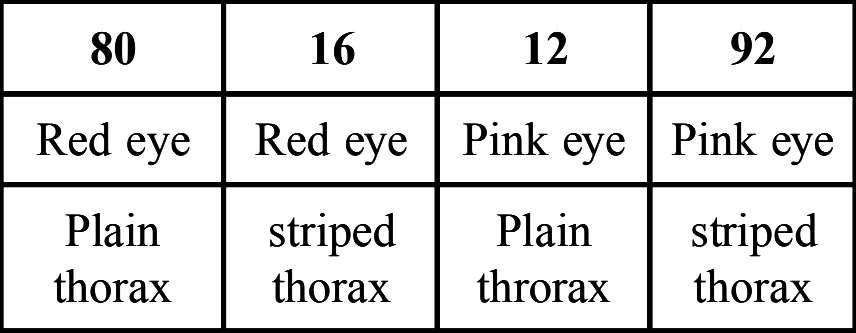
Q.114. True-breeding red-eyed Drosophila flies with plain thoraxes were crossed with pink-eyed flies with striped throaxes. Red eye plain throax × Pink eye striped throax The F 1 flies were then test crossed against the double recessive. The following F 2 generation resulted from the cross: 13 What percentage of recombinants resulted from the test cross?
Concept: Mendelian Genetics & Principles of Inheritance. Question 114 tests key NEET principles from NCERT Class 12 Biology, Chapter 5: Principles of Inheritance and Variation. Correct option: (2).
Q.115. Depending upon the distance between any two genes which is inversely proportional to the strength of linkage, cross overs will vary from:-
Concept: Linkage & Genetic Mapping. Question 115 tests key NEET principles from NCERT Class 12 Biology, Chapter 5: Principles of Inheritance and Variation. Correct option: (1).
Q.116. If map distance between genes P and Q is 4 units between P and R is 11 units, and between Q and R is 7 units, the order of genes on the linkage map can be tracted as follows.
Concept: Linkage & Genetic Mapping. Question 116 tests key NEET principles from NCERT Class 12 Biology, Chapter 5: Principles of Inheritance and Variation. Correct option: (4).
Q.117. More than two alternate forms of a gene present on the same locus are called (i) . They are produced due to repeated (ii) of the same gene but in different directions. Their well known example is (iii) . Which of thhe following correctly fills the above statement?
Concept: Mendelian Genetics & Principles of Inheritance. Question 117 tests key NEET principles from NCERT Class 12 Biology, Chapter 5: Principles of Inheritance and Variation. Correct option: (3).
Q.118. Males of silkworm Bombax mori are known to produce more silk per unit quantity of leaf consumed. Hence, they are preferably bred in sericulture industry. Which of the following genotypes should be crossed in order to get maximum fraction of male insects :- i. ii. iii. iv. SL 1 and SL 2 are sex-linked recessive lethal mutations.

Concept: Chromosomal Mutations & Aberrations. Question 118 tests key NEET principles from NCERT Class 12 Biology, Chapter 5: Principles of Inheritance and Variation. Correct option: (2).
Q.120. Refer to the following family tree. 14 If A = normal allele and a = albino allele, the genotypes of these parents are Father Mother
Concept: Mendelian Genetics & Principles of Inheritance. Question 120 tests key NEET principles from NCERT Class 12 Biology, Chapter 5: Principles of Inheritance and Variation. Correct option: (4).
Q.121. If fruit flies, long wing is dominant to vestigial wing. When heterozygous long - winged flies were crossed with vestigial-If an exact mendelian ratio had been obtained, then the number of each phenotype would have been Long - Winged Vestigial - Winged
Concept: Mendelian Genetics & Principles of Inheritance. Question 121 tests key NEET principles from NCERT Class 12 Biology, Chapter 5: Principles of Inheritance and Variation. Correct option: (3).
Q.122. In snapdragon plants, broad leaf is completely dominant to narrow leaf whereas red flower colour is incompletely dominant to ivory. (The genes for leaf width and flower colour are not linked). If plant which is heterozygous for both genes is crossed with a true - breeding broad - leaved red - flowered plant , then the expected proportion of broad - leaved plants with pink flowers amongst the offspring would be
Concept: Mendelian Genetics & Principles of Inheritance. Question 122 tests key NEET principles from NCERT Class 12 Biology, Chapter 5: Principles of Inheritance and Variation. Correct option: (2).
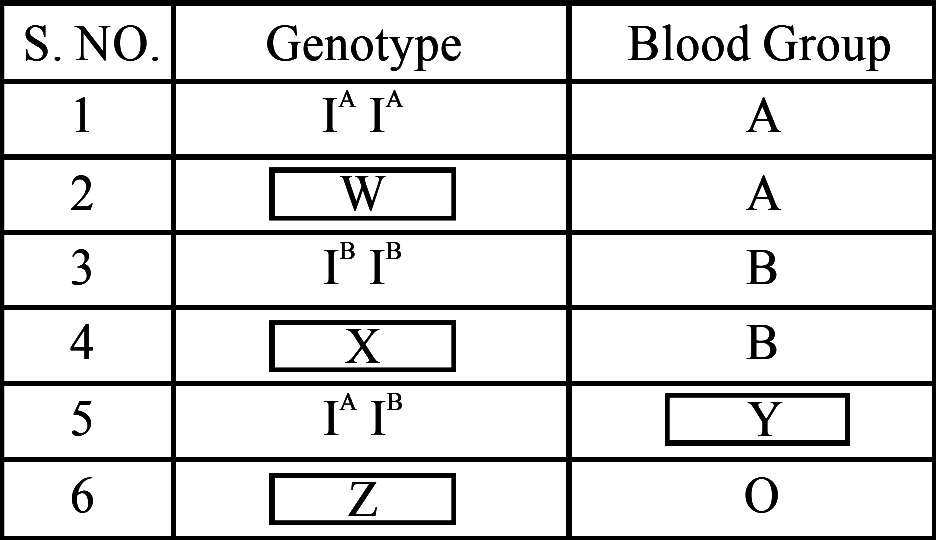
Q.124. The following table shows the genotypes for ABO blood grouping and their phenotypes. In which one of the four options the components of reaction labelled as W, X, Y and Z are identified correctly? W X Y Z
Concept: Co-Dominance & Multiple Alleles. Question 124 tests key NEET principles from NCERT Class 12 Biology, Chapter 5: Principles of Inheritance and Variation. Correct option: (4).
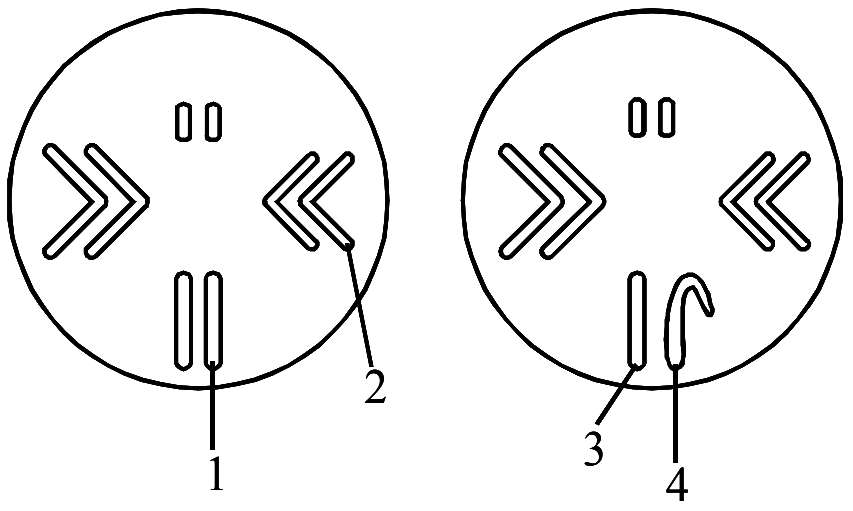
Q.125. The diagram ref er to the chromosome complement of each sex of fruit fly shown in the diagram - By which number is a Y chromosome labelled?
Concept: Mendelian Genetics & Principles of Inheritance. Question 125 tests key NEET principles from NCERT Class 12 Biology, Chapter 5: Principles of Inheritance and Variation. Correct option: (3).
Q.126. The following diagram shows two chromosomes. The lateral represent of genes. Which of the following would result if a translocation occured between chromosomes 1 and 2 ?
Concept: Mendelian Genetics & Principles of Inheritance. Question 126 tests key NEET principles from NCERT Class 12 Biology, Chapter 5: Principles of Inheritance and Variation. Correct option: (2).
Q.129. The following diagram shows two types of chromosomes mutation. These are called 1 2
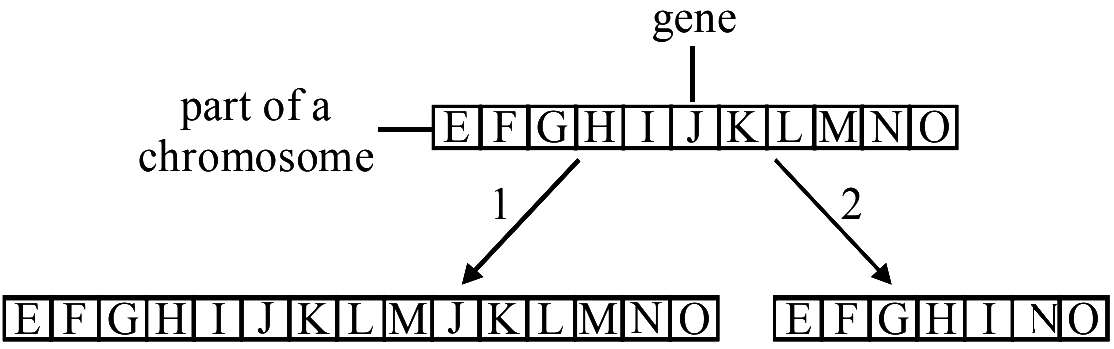
Concept: Chromosomal Mutations & Aberrations. Question 129 tests key NEET principles from NCERT Class 12 Biology, Chapter 5: Principles of Inheritance and Variation. Correct option: (1).
Q.130. Mendel's law of segregation states that :-
Concept: Mendelian Genetics & Principles of Inheritance. Question 130 tests key NEET principles from NCERT Class 12 Biology, Chapter 5: Principles of Inheritance and Variation. Correct option: (2).
Q.131. Kernal colour in corn is a trait determined by two alleles. The dominant allele (P) produces a purple colour, and the recessive allele (p) prduces a yellow colour. The diagram below shows an ear of corn produced by crossing two corn plants. The shaded kernels are purple, and the unshaded ones are yellow. The yellow kernels can be best described as
Concept: Mendelian Genetics & Principles of Inheritance. Question 131 tests key NEET principles from NCERT Class 12 Biology, Chapter 5: Principles of Inheritance and Variation. Correct option: (4).
Q.132. If Mendel had studied 8 traits using pea plant with 14 chromosomes, he would
Concept: Mendelian Genetics & Principles of Inheritance. Question 132 tests key NEET principles from NCERT Class 12 Biology, Chapter 5: Principles of Inheritance and Variation. Correct option: (4).
Q.133. If enough crosses are made between male flies of genotype Aa and the female flies of gentoypes aa to produce about 1000 offsprings, which one of the following is the most likely distribution of genotypes in the offsprings?
Concept: Mendelian Genetics & Principles of Inheritance. Question 133 tests key NEET principles from NCERT Class 12 Biology, Chapter 5: Principles of Inheritance and Variation. Correct option: (3).
Q.134. In an example of incomplete dominance, pure red flowers are crossed with pure white flowers and the F 1 individuals have pink flowers, which one of the following is not correct?
Concept: Mendelian Genetics & Principles of Inheritance. Question 134 tests key NEET principles from NCERT Class 12 Biology, Chapter 5: Principles of Inheritance and Variation. Correct option: (2).
Q.135. Normal maize has starchy seeds which remain smooth when dry. A mutant form has sugary seeds, which gowrinckled dry. when a mutant was crossed with a normal plant, an F 1 was produced which has smooth seeds. What would be the relative ratios of the different seed types, if the F 1 was allowed to self ?
Concept: Mendelian Genetics & Principles of Inheritance. Question 135 tests key NEET principles from NCERT Class 12 Biology, Chapter 5: Principles of Inheritance and Variation. Correct option: (1).
Q.137. Mendel found that the reciprocal crosses yielded identical results. From that
Concept: Mendelian Genetics & Principles of Inheritance. Question 137 tests key NEET principles from NCERT Class 12 Biology, Chapter 5: Principles of Inheritance and Variation. Correct option: (3).
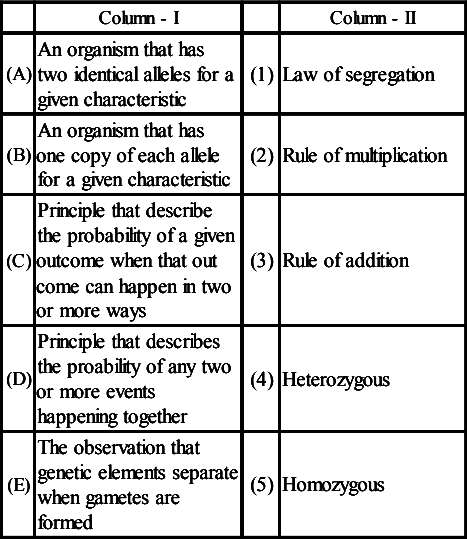
Q.138. Match the following columns :-
Concept: Mendelian Genetics & Principles of Inheritance. Question 138 tests key NEET principles from NCERT Class 12 Biology, Chapter 5: Principles of Inheritance and Variation. Correct option: (2).
Q.139. Match the definitions in column II with the correct term in column I. Column - I Column - II A. Codominance 1 True - breeding variety Cross between two B. Homozygous 2 hybrids Cross that involves two C. Heterozygous 3 different gene pairs An allele that is not D. Phenotype 4 expressed in the phenotype The physical Polygenic E. 5 characteristics (quantitative) of an individual Genotype with two F. Pleiotropy 6 different alleles Genotype with multiple G. Epistasis 7 alleles for same locus One gene influences H. Test cross 8 the Both alleles are fully I. Dihybrid cross 9 expressed in heterozygous Single gene with Incomplete J. 10 multiple dominance phenotypic effects Heterozygote is intermediate between 11 homozygous phenotypes Two or more gene with 12 additive effect on phenotype Cross with homozygous recessive to determine 13 genotype of unknown
Concept: Mendel Dihybrid & Monohybrid Crosses. Question 139 tests key NEET principles from NCERT Class 12 Biology, Chapter 5: Principles of Inheritance and Variation. Correct option: (1).
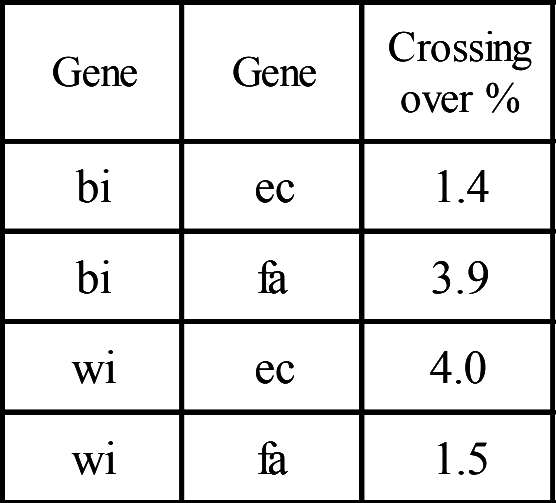
Q.140. In Drosophila, the following crossing over percentages were found What is the order of these genes?
Concept: Mendelian Genetics & Principles of Inheritance. Question 140 tests key NEET principles from NCERT Class 12 Biology, Chapter 5: Principles of Inheritance and Variation. Correct option: (4).
Q.141. One of the reason why haploids are considered more suitable than diploids for the study of mutation is that the haploids :-
Concept: Chromosomal Mutations & Aberrations. Question 141 tests key NEET principles from NCERT Class 12 Biology, Chapter 5: Principles of Inheritance and Variation. Correct option: (3).
Q.142. Dominant mutations are easier to detect than recessive mutations because they
Concept: Chromosomal Mutations & Aberrations. Question 142 tests key NEET principles from NCERT Class 12 Biology, Chapter 5: Principles of Inheritance and Variation. Correct option: (2).
Q.143. What are shown by A, B, C, D and E in the given figure
Concept: Mendelian Genetics & Principles of Inheritance. Question 143 tests key NEET principles from NCERT Class 12 Biology, Chapter 5: Principles of Inheritance and Variation. Correct option: (1).
Q.144. The linkage map of X - chromosomes of fruitfly has 66 units, with yellow body gen (y) at one end and bobbed hair (b) gene at the other end. The recombination frequency between these two genes (y and b) should be
Concept: Linkage & Genetic Mapping. Question 144 tests key NEET principles from NCERT Class 12 Biology, Chapter 5: Principles of Inheritance and Variation. Correct option: (4).
Q.145. Match the following columns :- Column - I Column - II A heritable disorder A. linked to genes on the 1 Linkage non - sex Traits close enough together on a B. 2 Autosomal chromosome disorder to segregate together The exchange occuring between homologous C. areas of the 3 Pedigree chromosome during meiosis An individual whose genome has one D. functional allele and 4 Heterozygous one non - functional allele. A heritable disease E. caused by the 5 Carrier presence A defective allele on the non - sex F. 6 Recombination chromosomes that causes a disease A chart of members of a single family Dominant G. 7 showing the occurance disorder patern of a disease 18
Concept: Pedigree Analysis. Question 145 tests key NEET principles from NCERT Class 12 Biology, Chapter 5: Principles of Inheritance and Variation. Correct option: (3).
Q.147. In human, red - green colour blindness is a sex - linked recessive while albinism is Autosomal recessive. A marriage between two homozygous parents, a normal visioned albino woman and a colourblind and normally pigmented man will produce children
Concept: Mendelian Genetics & Principles of Inheritance. Question 147 tests key NEET principles from NCERT Class 12 Biology, Chapter 5: Principles of Inheritance and Variation. Correct option: (1).
Q.148. Sita and Ram have their first child. Sita know her blood type is A, but Ram does not know his blood type. However, Ram knows that both his mother and father have type B blood, the first child is a boy named kush. Kush has type O blood. Sita and Ram do not understand how this happened. Which of the following is the best explanation
Concept: Mendelian Genetics & Principles of Inheritance. Question 148 tests key NEET principles from NCERT Class 12 Biology, Chapter 5: Principles of Inheritance and Variation. Correct option: (4).
Q.149. Usually, the recessive character is expressed only when present in a double recessive condition. However, single recessive gene can express itself in human beings when the gene is present on
Concept: Mendelian Genetics & Principles of Inheritance. Question 149 tests key NEET principles from NCERT Class 12 Biology, Chapter 5: Principles of Inheritance and Variation. Correct option: (3).
Q.150. Study the two cases carefully. The correct interpretation of the two cases is
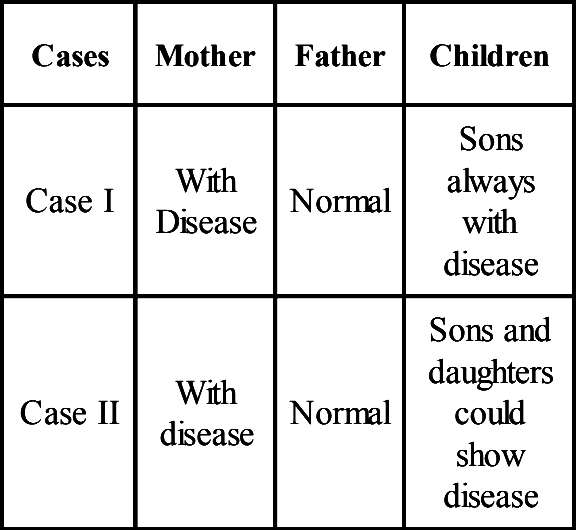
Concept: Mendelian Genetics & Principles of Inheritance. Question 150 tests key NEET principles from NCERT Class 12 Biology, Chapter 5: Principles of Inheritance and Variation. Correct option: (2).
Q.151. What will the phenotype sex of the following organism on the basis of the sex chromosomal constitution indicated against each organism? Select the correct answer using the codes given below Male Female
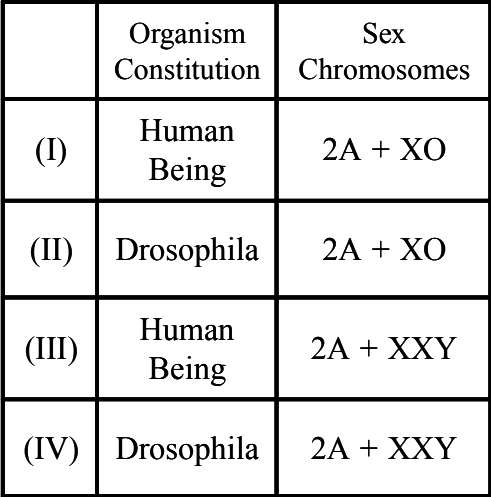
Concept: Mendelian Genetics & Principles of Inheritance. Question 151 tests key NEET principles from NCERT Class 12 Biology, Chapter 5: Principles of Inheritance and Variation. Correct option: (1).
Q.152. In a family, father had a particular trait but mother did not show it. Their two sons are normal but their daughter had that trait. The daughter was married to a normal person and her daughter has the trait.
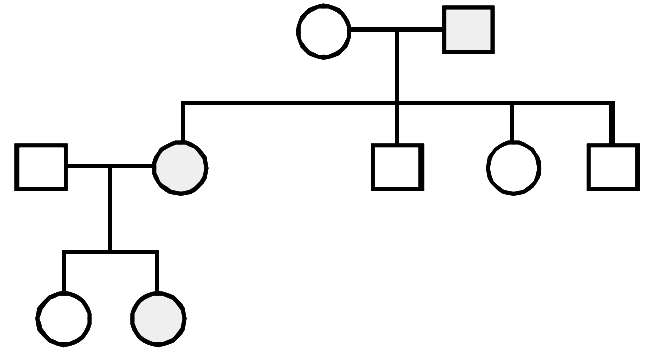
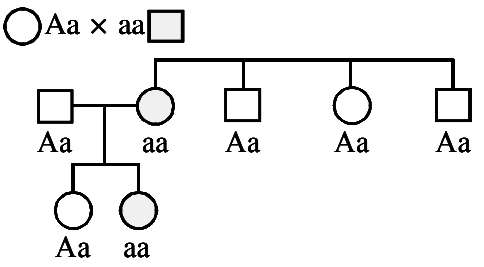
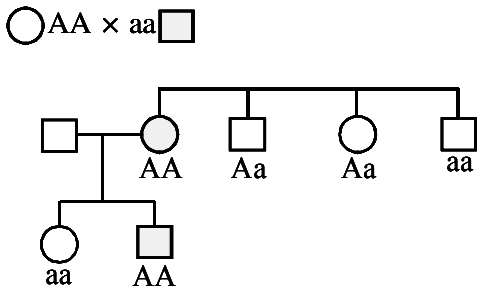
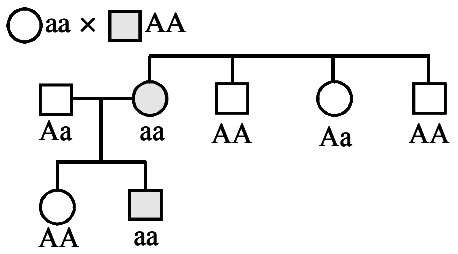
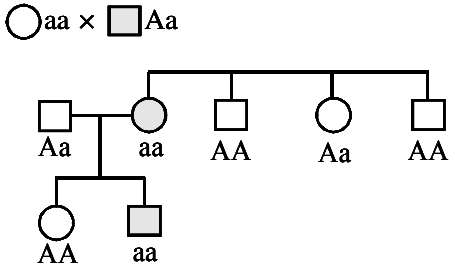
Concept: Mendelian Genetics & Principles of Inheritance. Question 152 tests key NEET principles from NCERT Class 12 Biology, Chapter 5: Principles of Inheritance and Variation. Correct option: (4).
Q.153. Mark the given statements True (T) or False (F). (i) Inheritance is the process by which characters are passed on from parents to progeny. (ii) Mendel conducted hybridisation experiment on wild peas for seven years and proposed the laws ofinheritance in living organisms. (iii) The first hybrid generation is also called filial progeny or F2. (iv) In a monohybrid cross, the phenotypic and genotypic ratio in F2 generation is 3:1 and 1:2:1 respectively. (v) According to Mendel, characters are controlled by discrete units called factors and now we call them genes. (vi) Genes which code for a pair of contrasting traits are known as alleles. (vii) For a character like height, TT and tt are called phenotype of organism while descriptive terms tall and dwarf are genotype (viii)Both the alleles can be similar in case of homozygotes (eg. TT or tt) or can be dissimilar as in the case of heterozygote (eg. Tt) for a particular trait (eg. height). (ix) During the process of meiosis, the segregation of alleles is a random process and so there is a 50% chance ofa gamete containing either allele. (x) The symbols ? and are used to denote male (pollen) and female (egg) respectively. (xi) For a trait height, the genotype of Tt has the phenotypic character tall. Choose the correct option given below:
Concept: Mendel Dihybrid & Monohybrid Crosses. Question 153 tests key NEET principles from NCERT Class 12 Biology, Chapter 5: Principles of Inheritance and Variation. Correct option: (3).
Q.154. Which one of the following statements are correct (i) When an organism showing a dominant phenotype is crossed with the dominant parent instead of self crossing, then the cross is called test cross. (ii) If the result of test cross shows half of the progeny with dominant trait and half recessive trait, then the unknown genotype of parent is interpreted to be heterozygous. (iii) In incomplete dominance, the F, had a phenotype that did not resemble either of the two parents and is between the two. (iv) In incomplete dominance, the phenotypic ratio is 3: 1 and the genotypic ratio is 1:2:1. (v) The study on plant Antirrhinum sp. is good example of incomplete dominance and that on ABO blood group in human being is an example of Co-dominance. (vi) In case of Co-dominance, F 1 generation resembles both parents. (vii) The phenotypic ratio of dihybrid cross is 9:3:1. (viii)In 1900, three scientist de Vries, Correns and Von Tschermak independently rediscovered Mendel's result on the inheritance of character. (ix) Sutton united the knowledge of chromosomal segregation with Mendelian principle and called it the chromosomal theory of inheritance. (x) Morgan coined the term linkage to describe physical association of genes on aa chromosome and the term recombination to describe the generation of parental gene combination. (xi) The chromosomes involved in the determination of sex is designated as sex chromosome and the rest of chromosomes is called autosome. Choose the correct option given below:
Concept: Linkage & Genetic Mapping. Question 154 tests key NEET principles from NCERT Class 12 Biology, Chapter 5: Principles of Inheritance and Variation. Correct option: (2).
Q.155. (i) Grasshopper is an example of XO type of sex determination in which males have only X- chromosome besides autosomes, whereas female have a pair of X-chromosome. (ii) In mammals including man, XY type of sex determination is seen where both male and (iii) The XO and XY sex determination mechanism are designated to be example of female heterogamety whereas ZW sex determination mechanism are designated to be example of male heterogamety. (iv) In birds the female have zw chromosome whereas males have zz chromosome besides autosomes (v) The mutation arising due to change in a single base of DNA is known as point mutation (vi) The chemical and physical factors that induce mutation are reffered to as mutagens. 21 (vii) An analysis of traits in a several generation of a family is called pedigree analysis. (viii)In pedigree analysis the symbol represents affected individuals and the symbol represents consanguineous mating. (ix) Sickle-cell anaemia and phenylketonuria are example of X-linked recessive trait. (x) Myotonic dystrophy is example of autosomal recessive trait. (xi) Haemophilia is sex-linked recessive disease in which heterozygous female may transmit the diseases to sons. Choose the option with incorrect statements.
Concept: Pedigree Analysis. Question 155 tests key NEET principles from NCERT Class 12 Biology, Chapter 5: Principles of Inheritance and Variation. Correct option: (1).
Q.156. Fll in the blanks (i) Sickle-cell anaemia is caused by the substitution of _A_by _B_ at 6th position of the _C_ globin chain of Haemoglobin. (ii) In phenylketonuria, the individual lacks an enzyme that converts the amino acid phenylalanine into _D_. (iii) Failure of segregation of chromatids during cell division cycle results in the gain or loss of a chromosome calle _E_. (iv) In _F_, there is an increase in a whole set of chromosome in an organism. (v) Down's syndrome is genetic disorder because of presence of an additional copy of chromosome number _G_. (vi) In _H_ syndrome, there is an additional copy of X-chromosome resulting into a karyotype of 47,. XXY. (vii) In _I_ syndrome, there is an absence of one of the X-chromosome, i.e. 45 with XO. (viii)The traits that are generally controlled by 3 or more genes are called _J_ traits. (ix) When single gene exhibit multiple phenotypic expression, it is called _K_ gene. (x) In honey bee, females are _L_ having _M_ chromosome and males are _N_ having 16 _O_ sex- chromosome. This is called determination system (xi) Colour blindness is _P_-linked _Q_ disorder. This defect is due to mutation in certain genes present in _R_ chromosome. (xii) Thalassemia is _S_-linked _T_ discase. It is controlled by two closely linked genes _U_ and Von chromosome W ofeach parent. Choose the correct option given below.
Concept: Chromosomal Mutations & Aberrations. Question 156 tests key NEET principles from NCERT Class 12 Biology, Chapter 5: Principles of Inheritance and Variation. Correct option: (4).
Q.158. Match the column I with column II and choose the correct option. Column-I Column-II Law of Testis determining A. I. segregation factor B. Gene mutation II. 2n+1 C. Y-chromosone III. Drosophila Base pairs D. Trisomy IV. substitution assortment Incomplete E. V. Antirrhinum sp. dominance F. Dihybrid cross VI. 2n-2 22 A B C D E F
Concept: Chromosomal Mutations & Aberrations. Question 158 tests key NEET principles from NCERT Class 12 Biology, Chapter 5: Principles of Inheritance and Variation. Correct option: (2).
Q.159. Given pedigree represents inheritance of myotonic dystrophy which is an autosomal dominant disorder.What will be genotype of parents?
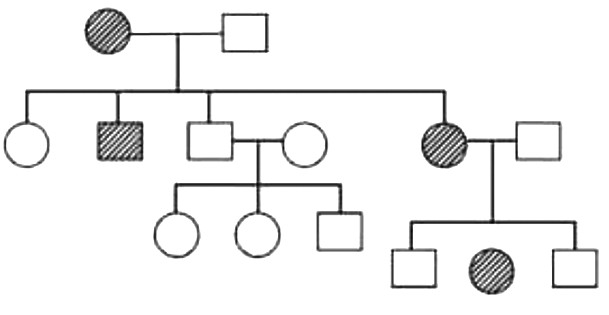
Concept: Pedigree Analysis. Question 159 tests key NEET principles from NCERT Class 12 Biology, Chapter 5: Principles of Inheritance and Variation. Correct option: (3).
Q.160. Given pedigree chart shows inheritance of autosomal recessive trait (for eg sickle cell anaemia) then what will be genotype of parent? (1) Father - (Aa) Mother - (aa) (2 Father - (aa) Mother -(aa) (3) Father -(Aa) Mother -(Aa) (4) Father -(AA) Mother-(AA)
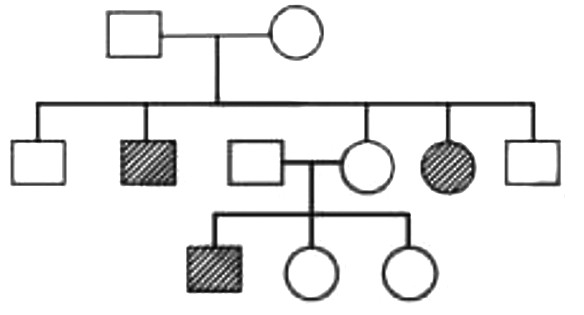
Concept: Pedigree Analysis. Question 160 tests key NEET principles from NCERT Class 12 Biology, Chapter 5: Principles of Inheritance and Variation. Correct option: (3).
Q.161. A diploid organism is heterozygous for 4 loci, how many types of gametes can be produced? (1)8 (2) 16 (3) 2 (4) 32
Concept: Mendelian Genetics & Principles of Inheritance. Question 161 tests key NEET principles from NCERT Class 12 Biology, Chapter 5: Principles of Inheritance and Variation. Correct option: (3).
Q.162. An individual with AaBb genotype is producing four types of gametes as AB, aB, Ab and ab by meiosis. If the frequency of these gametes is 25% each then, it explains
Concept: Mendelian Genetics & Principles of Inheritance. Question 162 tests key NEET principles from NCERT Class 12 Biology, Chapter 5: Principles of Inheritance and Variation. Correct option: (2).
Q.164. A pedigree chart is given below Find the possible parental combination for this case
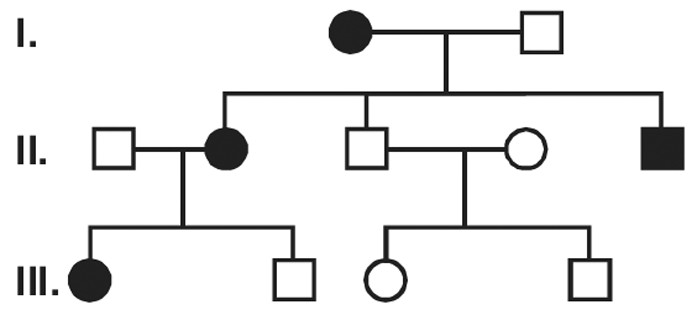
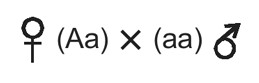
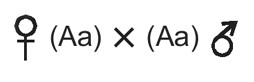
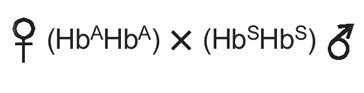
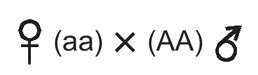
Concept: Pedigree Analysis. Question 164 tests key NEET principles from NCERT Class 12 Biology, Chapter 5: Principles of Inheritance and Variation. Correct option: (4).
Q.165. A dihybrid test cross produced the following offsprings AB/ab 960 Ab/ab 60 aB/ab 40 ab/ab 940 What is the distance between gene A and B?
Concept: Mendel Dihybrid & Monohybrid Crosses. Question 165 tests key NEET principles from NCERT Class 12 Biology, Chapter 5: Principles of Inheritance and Variation. Correct option: (3).
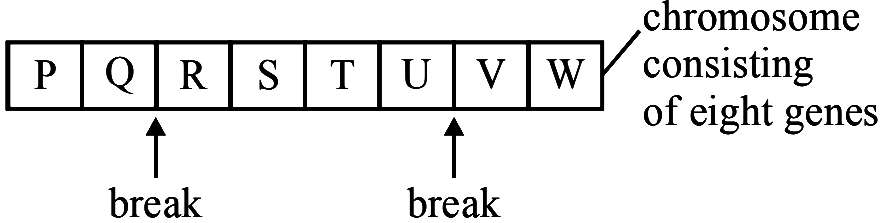
Q.166. Following figure represents which type of chromosomal aberration?
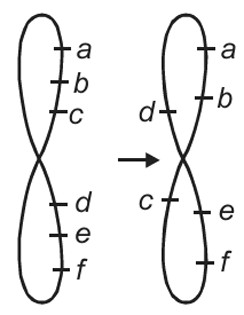
Concept: Chromosomal Mutations & Aberrations. Question 166 tests key NEET principles from NCERT Class 12 Biology, Chapter 5: Principles of Inheritance and Variation. Correct option: (3).
Q.168. A trihybrid cross is made for height, flower colour and shape of seed in pea, how many progenies are expected with first recessive, second heterozygous dominant and third dominant character? 8 6 (1) (2) 64 64 16 4 (3) (4) 64 64
Concept: Mendelian Genetics & Principles of Inheritance. Question 168 tests key NEET principles from NCERT Class 12 Biology, Chapter 5: Principles of Inheritance and Variation. Correct option: (4).
Q.169. Find the probability of gametes having genotype PqR for the three incompletely linked genes shown in the given below diagram
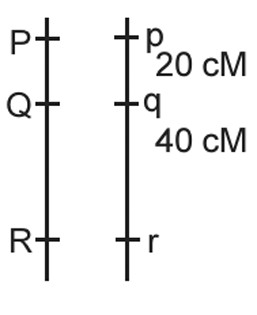
Concept: Mendelian Genetics & Principles of Inheritance. Question 169 tests key NEET principles from NCERT Class 12 Biology, Chapter 5: Principles of Inheritance and Variation. Correct option: (3).
Q.170. Which set of gametes will be produced by the genotype AaBbCc, if last two genes are completely linked?
Concept: Mendelian Genetics & Principles of Inheritance. Question 170 tests key NEET principles from NCERT Class 12 Biology, Chapter 5: Principles of Inheritance and Variation. Correct option: (2).
Q.171. Find the correct genotypes of the parents and other offsprings, if the child has blood group ‘O’ father has blood group ‘A’ and mother blood group B
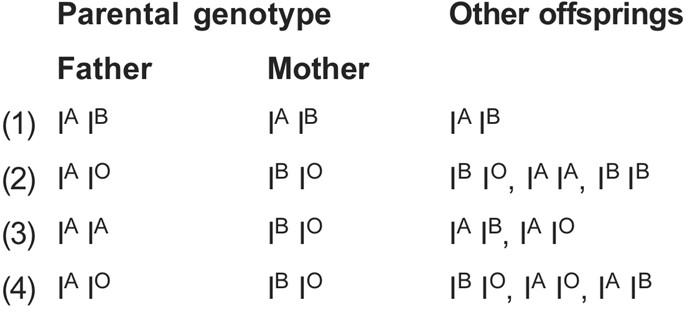
Concept: Co-Dominance & Multiple Alleles. Question 171 tests key NEET principles from NCERT Class 12 Biology, Chapter 5: Principles of Inheritance and Variation. Correct option: (1).
Q.172. Match the genetic phenomenon with their respective ratios
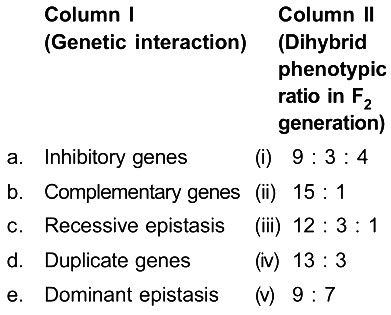
Concept: Mendelian Genetics & Principles of Inheritance. Question 172 tests key NEET principles from NCERT Class 12 Biology, Chapter 5: Principles of Inheritance and Variation. Correct option: (4).
Q.173. Study the pedigree chart given below and select the set of correct statements 24 a. It shows inheritance of autosomal disease like cystic fibrosis b. Genotype of II-3 will be AA c. It shows inheritance of autosomal dominant disease like polydactyly d. Genotype of I-2 will be Aa Correct statements are :
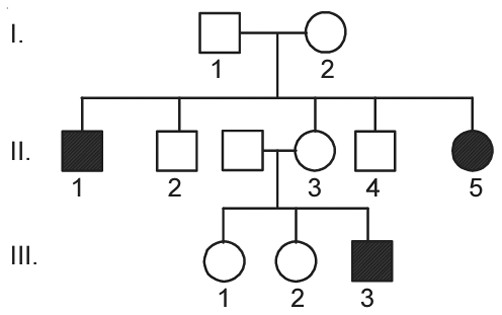
Concept: Pedigree Analysis. Question 173 tests key NEET principles from NCERT Class 12 Biology, Chapter 5: Principles of Inheritance and Variation. Correct option: (3).
Q.174. All white eyed male Drosophila can be obtained from which one of the following cross?
Concept: Mendelian Genetics & Principles of Inheritance. Question 174 tests key NEET principles from NCERT Class 12 Biology, Chapter 5: Principles of Inheritance and Variation. Correct option: (2).
Q.175. Genotype of parent’s blood group which cannot produce same blood group type in genotype of their offspring is
Concept: Co-Dominance & Multiple Alleles. Question 175 tests key NEET principles from NCERT Class 12 Biology, Chapter 5: Principles of Inheritance and Variation. Correct option: (1).
Q.176. Given below is a pedigree chart showing the inheritance of a certain trait in humans The best possible explanation of trait traced in the above chart is
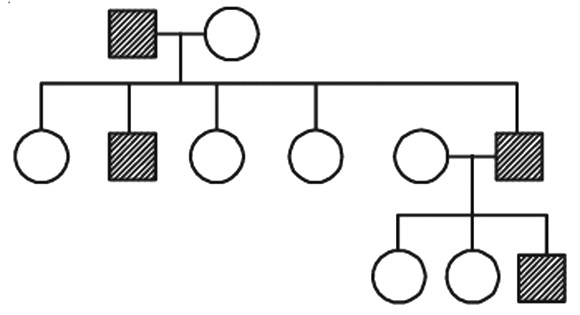
Concept: Pedigree Analysis. Question 176 tests key NEET principles from NCERT Class 12 Biology, Chapter 5: Principles of Inheritance and Variation. Correct option: (4).
Q.177. Which of the following is a non-parental type of progeny obtained by Morgan while carrying out dihybrid cross? (1) (2) (3) (4)
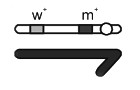
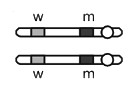
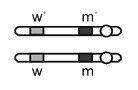
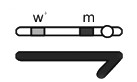
Concept: Linkage & Genetic Mapping. Question 177 tests key NEET principles from NCERT Class 12 Biology, Chapter 5: Principles of Inheritance and Variation. Correct option: (3).
Q.178. Which of the following pedigree chart represents inheritance of hypertrichosis?
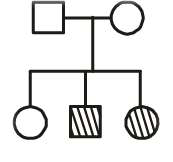
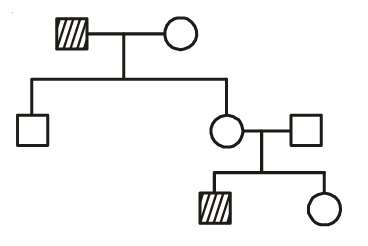
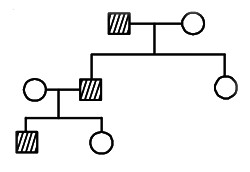
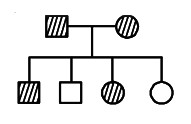
Concept: Pedigree Analysis. Question 178 tests key NEET principles from NCERT Class 12 Biology, Chapter 5: Principles of Inheritance and Variation. Correct option: (2).
Q.180. Gmn-l: Disease / Condition | Column-II: Inheritance Type Disease/ Condition Type Code Huntington's Autosomal 1 P chorea Dominant Myotonic Autosomal 2 Q dystrophy Recessive X-linked 3 Polydactyly R Dominant X-linked 4 Phenylketonuria (PKU) S Recessive 5 Tay-Sachs disease Y-linked T 6 Albinism 7 Sickle cell anaemia 8 Cystic fibrosis 9 Thalassemia Pseudovitamin-D 10 deficiency rickets Dentine enamel 11 dysplasia 12 Haemophilia 13 Colour blindness Duchenne muscular 14 dystrophy 15 G6PD deficiency Hypertrichosis 16 pinnae auris 17 Porcupine skin 18 Webbed toes 19 SRY gene 20 Alkaptonuria
Concept: Mendelian Genetics & Principles of Inheritance. Question 180 tests key NEET principles from NCERT Class 12 Biology, Chapter 5: Principles of Inheritance and Variation. Correct option: (1).