NEET Botany High-Yield: Genetics & Plant Physiology Sprint
Subject-Wise Performance Analysis
| Subject | Attempted / Total | Correct (+4) | Incorrect (-1) | Accuracy % | Net Subject Score |
|---|---|---|---|---|---|
| Botany | 0 / 32 | 0 | 0 | 0% | 0 |
Question-by-Question NCERT Solutions
Review your chosen responses with full textbook references
Q.1. Regarding the following cross AaBbCcDd×AABbCcDD Which statement is correct?
Concept: Mendelian Genetics & Principles of Inheritance. Question 1 tests key NEET principles from NCERT Class 12 Biology, Chapter 5: Principles of Inheritance and Variation. Correct option: (3).
Q.2. Given below are two statements; one is labelled as Assertion (A) and the other is labelled as Reason (R). Assertion (A): Unmodified Allele, which represents the original phenotype is the dominant allele Reason (R): A dominant allele could be modified into recessive allele by only crossing over In the light of the above statements, choose the correct answer from the options given below :
Concept: Mendelian Genetics & Principles of Inheritance. Question 2 tests key NEET principles from NCERT Class 12 Biology, Chapter 5: Principles of Inheritance and Variation. Correct option: (2).
Q.3. Proportion of progenies with round seeded and red flowered pea plants if cross is made between WwRr and ww Rr would be :-
Concept: Mendelian Genetics & Principles of Inheritance. Question 3 tests key NEET principles from NCERT Class 12 Biology, Chapter 5: Principles of Inheritance and Variation. Correct option: (1).
Q.4. Ratio of dominant and recessive for both character plants in F 2 generation of dihybrid cross is :-
Concept: Mendel Dihybrid & Monohybrid Crosses. Question 4 tests key NEET principles from NCERT Class 12 Biology, Chapter 5: Principles of Inheritance and Variation. Correct option: (4).
Q.5. What is the probability of gamete AbC produced by a plant having genotype AaBbCc (If all the genes are situated on different chromosomes)?
Concept: Mendelian Genetics & Principles of Inheritance. Question 5 tests key NEET principles from NCERT Class 12 Biology, Chapter 5: Principles of Inheritance and Variation. Correct option: (3).
Q.6. Identify A, B and C in the given representative figure showing an individual inflicted with down syndrome. A B C Small and Flat back Broad
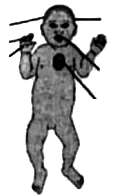
Concept: Chromosomal Disorders (Down, Turner, Klinefelter). Question 6 tests key NEET principles from NCERT Class 12 Biology, Chapter 5: Principles of Inheritance and Variation. Correct option: (2).
Q.7. A plant has genotype TtRrGgPP. On selfing of this plant, what is the sum total of phenotypic categories ?
Concept: Mendelian Genetics & Principles of Inheritance. Question 7 tests key NEET principles from NCERT Class 12 Biology, Chapter 5: Principles of Inheritance and Variation. Correct option: (1).
Q.8. Total number of genotypes and phenotypes in a dihybrid test cross is -
Concept: Mendel Dihybrid & Monohybrid Crosses. Question 8 tests key NEET principles from NCERT Class 12 Biology, Chapter 5: Principles of Inheritance and Variation. Correct option: (4).
Q.9. Which of the following crosses will produce 1 : 1 phenotypic ratio :-
Concept: Mendelian Genetics & Principles of Inheritance. Question 9 tests key NEET principles from NCERT Class 12 Biology, Chapter 5: Principles of Inheritance and Variation. Correct option: (3).
Q.10. What is the probability of obtaining pure homozygous individuals, if a cross is made between AaBbCcDd × aaBBCCdd individuals ? 2 1 (1) (2) 16 16 16 1 (3) (4) 248 64 2
Concept: Mendelian Genetics & Principles of Inheritance. Question 10 tests key NEET principles from NCERT Class 12 Biology, Chapter 5: Principles of Inheritance and Variation. Correct option: (2).
Q.11. Match Column I with Column II with respect to the scientists and their contributions in the development of genetics, as described in NCERT. Column I- Column II- Scientist Contribution/ W ork Experimental verification Gregor Johann A. 1 of chromosomal theory of Mendel inheritance Proposed the chromosomal B. Hugo de Vries 2 theory of inheritance along with Boveri Conducted hybridisation experiments on garden pea C. Carl Correns 3 and proposed laws of inheritance Erich von D. 4 Proposed mutation theory Tschermak Walter Independently rediscovered E. 5 Sutton Mendel's work Theodor Independently rediscovered F. 6 Boveri Mendel's work Thomas Hunt Independently rediscovered G. 7 Morgan Mendel's work Used recombination Alfred H. 8 frequency to map genes Sturtevant on chromosomes Which one of the following represents the correct matching?
Concept: Linkage & Genetic Mapping. Question 11 tests key NEET principles from NCERT Class 12 Biology, Chapter 5: Principles of Inheritance and Variation. Correct option: (1).
Q.12. A diploid organism is heterozygous for 3 loci, how many types of gametes can be produced?
Concept: Mendelian Genetics & Principles of Inheritance. Question 12 tests key NEET principles from NCERT Class 12 Biology, Chapter 5: Principles of Inheritance and Variation. Correct option: (4).
Q.13. Maximum height of a plant is 30ft. and minimum height is 10 ft. If plant height is controlled by 3 pairs of genes, then the height of plant with genotype AaBbCc will be -
Concept: Mendelian Genetics & Principles of Inheritance. Question 13 tests key NEET principles from NCERT Class 12 Biology, Chapter 5: Principles of Inheritance and Variation. Correct option: (3).
Q.14. If all the four children of a family will not have similar blood group, than what will be the blood group genotype of father & mother ?
Concept: Co-Dominance & Multiple Alleles. Question 14 tests key NEET principles from NCERT Class 12 Biology, Chapter 5: Principles of Inheritance and Variation. Correct option: (2).
Q.15. The ratio between carrier, disease free & diseased individual on marriage between two carriers of sickle cell anaemia will be -
Concept: Mendelian Genetics & Principles of Inheritance. Question 15 tests key NEET principles from NCERT Class 12 Biology, Chapter 5: Principles of Inheritance and Variation. Correct option: (1).
Q.16. A monohybrid cross between two plants, one having 24 cm long internode and other having 12 cm long internode, produces F 1 hybrid, all having 18 cm long internodes. This is a case of
Concept: Mendel Dihybrid & Monohybrid Crosses. Question 16 tests key NEET principles from NCERT Class 12 Biology, Chapter 5: Principles of Inheritance and Variation. Correct option: (4).
Q.17. In a linear chromosome, map distance between four loci are ab = 12, bc = 4, ad = 2, ac = 8. The distance between c and d will be -
Concept: Mendelian Genetics & Principles of Inheritance. Question 17 tests key NEET principles from NCERT Class 12 Biology, Chapter 5: Principles of Inheritance and Variation. Correct option: (3).
Q.18. What will be the percentage inheritance of a disorder from an X-linked diseased father to his son.
Concept: Mendelian Genetics & Principles of Inheritance. Question 18 tests key NEET principles from NCERT Class 12 Biology, Chapter 5: Principles of Inheritance and Variation. Correct option: (2).
Q.19. A homozygous recessive with cd genes was crossed with dominant (+ +). If their hybrid is test crossed and the following results were obtained + + - 900 c d - 880 + d - 115 + c - 105 Than what will be the distance between genes c and d.
Concept: Mendelian Genetics & Principles of Inheritance. Question 19 tests key NEET principles from NCERT Class 12 Biology, Chapter 5: Principles of Inheritance and Variation. Correct option: (1).
Q.20. Two genes a and b are linked and show 30% recombination. If ++ / ++ individual married with ab / ab then the types and proportion of gametes produced by F 1 will be -
Concept: Linkage & Genetic Mapping. Question 20 tests key NEET principles from NCERT Class 12 Biology, Chapter 5: Principles of Inheritance and Variation. Correct option: (4).
Q.21. A dihybrid plant with genotype PpNn. It produces four types of gametes in following number PN = 200, pn = 200, Pn = 800, pN = 800 then what is the distance between linked genes?
Concept: Mendel Dihybrid & Monohybrid Crosses. Question 21 tests key NEET principles from NCERT Class 12 Biology, Chapter 5: Principles of Inheritance and Variation. Correct option: (3).
Q.22. Find out the % of plants, which are dominant for both the character by the cross of with ab it's recessive form, if 20% recombination is present:-
Concept: Linkage & Genetic Mapping. Question 22 tests key NEET principles from NCERT Class 12 Biology, Chapter 5: Principles of Inheritance and Variation. Correct option: (2).
Q.23. Four genes A, B, C and D located on chromosome and cross over frequencies between different genes are : A – D 20%, A – C ? 4% C – D 16%, B – C ? 9% A – B = 5% Based on above data, what is the arrangement of linked genes on chromosome
Concept: Mendelian Genetics & Principles of Inheritance. Question 23 tests key NEET principles from NCERT Class 12 Biology, Chapter 5: Principles of Inheritance and Variation. Correct option: (1).
Q.24. A woman of normal vision whose father was colourblind, marries a man of normal vision, whose father was also colourblind. The sons of this marriage would be :-
Concept: Mendelian Genetics & Principles of Inheritance. Question 24 tests key NEET principles from NCERT Class 12 Biology, Chapter 5: Principles of Inheritance and Variation. Correct option: (4).
Q.25. By the cross of F 1 linked dihybrid plant with a plant of genotype aabb, we get the 1300 plants out of 2000 of parental type. The distance between A and B gene is :-
Concept: Mendel Dihybrid & Monohybrid Crosses. Question 25 tests key NEET principles from NCERT Class 12 Biology, Chapter 5: Principles of Inheritance and Variation. Correct option: (3).
Q.26. Genotype of plant is and there is 18% ab recombination present in it then percentage of gametes will be :-
Concept: Linkage & Genetic Mapping. Question 26 tests key NEET principles from NCERT Class 12 Biology, Chapter 5: Principles of Inheritance and Variation. Correct option: (2).
Q.27. Find out the number of dominant individual in a population of 6000, if the frequency of recessive phenotype is 25%
Concept: Mendelian Genetics & Principles of Inheritance. Question 27 tests key NEET principles from NCERT Class 12 Biology, Chapter 5: Principles of Inheritance and Variation. Correct option: (1).
Q.28. The frequency of an autosomal recessive allele is 0.4. Then what will be the frequency of heterozygotes in progeny among 4000 individual?
Concept: Mendelian Genetics & Principles of Inheritance. Question 28 tests key NEET principles from NCERT Class 12 Biology, Chapter 5: Principles of Inheritance and Variation. Correct option: (4).
Q.29. Find out the number of heterozygous free ear lobed persons in a population of 3000 if the proportion of fused ear lobed persons is 9%:
Concept: Mendelian Genetics & Principles of Inheritance. Question 29 tests key NEET principles from NCERT Class 12 Biology, Chapter 5: Principles of Inheritance and Variation. Correct option: (3).
Q.30. If in a population, frequency of organisms of recessive trait is 25% then calculate the frequency of recessive allele :
Concept: Mendelian Genetics & Principles of Inheritance. Question 30 tests key NEET principles from NCERT Class 12 Biology, Chapter 5: Principles of Inheritance and Variation. Correct option: (2).
Q.31. If the frequency of recesive phenotype is 9% then find out the number of homozygous organisms in population of 50,000 individuals:-
Concept: Mendelian Genetics & Principles of Inheritance. Question 31 tests key NEET principles from NCERT Class 12 Biology, Chapter 5: Principles of Inheritance and Variation. Correct option: (1).
Q.32. In the pedigree shown below, individuals with the solid symbols suffers from albinism. You would counsel the couple A & B that the probability that each of their child will have the disease is :-
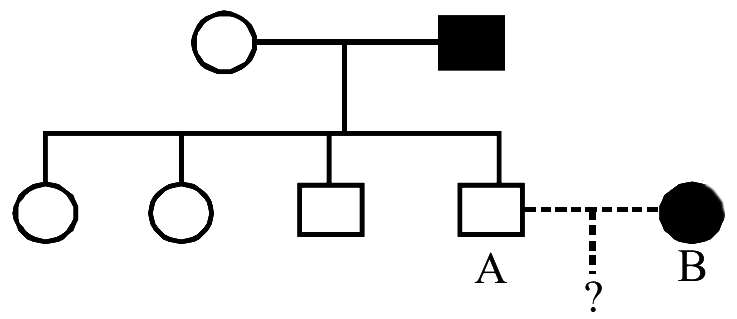
Concept: Pedigree Analysis. Question 32 tests key NEET principles from NCERT Class 12 Biology, Chapter 5: Principles of Inheritance and Variation. Correct option: (3).